I’m Kaye, fifty-seven, and Mum is eighty-three. She lives in a small unit near Wollongong with a balcony full of plants and a fierce opinion about how much water a lemon tree needs. My brother Ross lives fifteen minutes away. I live two hours away and work weekends at a library, so most of my visits have to be planned carefully. We had a routine: phone calls on Wednesdays, a handwritten card from me every Sunday and a proper visit when our rosters lined up.
I began sending cards after Mum hurt her wrist and found holding her phone uncomfortable. At first she talked about them on our calls. She liked the ones with birds on the front and complained cheerfully when I used the same joke twice. Then, around autumn, the calls changed. She said she was tired. She asked me to speak to Ross about arrangements. When I mentioned a card I’d sent, she changed the subject. I assumed she wanted some quiet while she recovered.
Ross was doing a lot. He helped with shopping, sorted appointment letters and took the bins out. I never resented that he was closer. In fact, I worried he felt I was leaving him with the practical work while I sent pretty paper from a distance. Whenever I offered to come down for a weekend, he told me Mum was resting or had visitors. I tried not to be the sister who turns up from out of town and announces that everything should be done differently.
In early spring I finally arranged a weekday off and visited without making a grand occasion of it. Mum opened the door wearing the cardigan I’d given her last Christmas. She hugged me, then drew back with tears in her eyes. ‘I thought you’d stopped writing,’ she said. ‘I kept watching the letterbox.’
I laughed at first because I thought she was teasing. I had bought twenty-six cards in a single sale at the local post office. I had written about the library, my daughter’s driving lessons, a neighbour’s noisy dog and the first tomatoes in our garden. Nothing dramatic. I could remember each envelope because I’d worried over the stamps. Mum wasn’t laughing. She said Ross had told her I was too busy to write and that she should leave me alone.
I felt anger rise so quickly that I had to sit down. I asked if she was certain. She nodded. Her memory was still sharp; she could describe the flowers on the last card she’d received, back before her wrist injury. She had asked Ross once whether anything had arrived, and he said there was nothing. After a while she stopped asking because she didn’t want to be a bother.
Ross arrived while we were having tea. He looked startled to see me. I asked him, in front of Mum, whether the cards had been delivered to the wrong address. He said he had taken care of the mail because some scam letters had frightened her. He avoided my eyes. Mum asked again whether I had written. I said yes, every week. She reached for my hand and asked why she hadn’t seen any of them.
Ross said he’d meant to talk to me. He thought I was putting pressure on Mum by sending frequent cards when she was unwell. He had put them away until she felt stronger, then didn’t know how to explain the delay. I asked where they were. He said in a box in his car. Mum stood up so abruptly that her cup rattled in its saucer. ‘Those are my letters,’ she said.
I wanted to shout. I wanted to tell Ross he had stolen seven months of little conversations I could never repeat in quite the same way. But Mum was standing between us looking smaller than either of us had seen her in years. She was frightened we would argue and leave again. I asked Ross to bring the box inside. He went out to his car without another word.
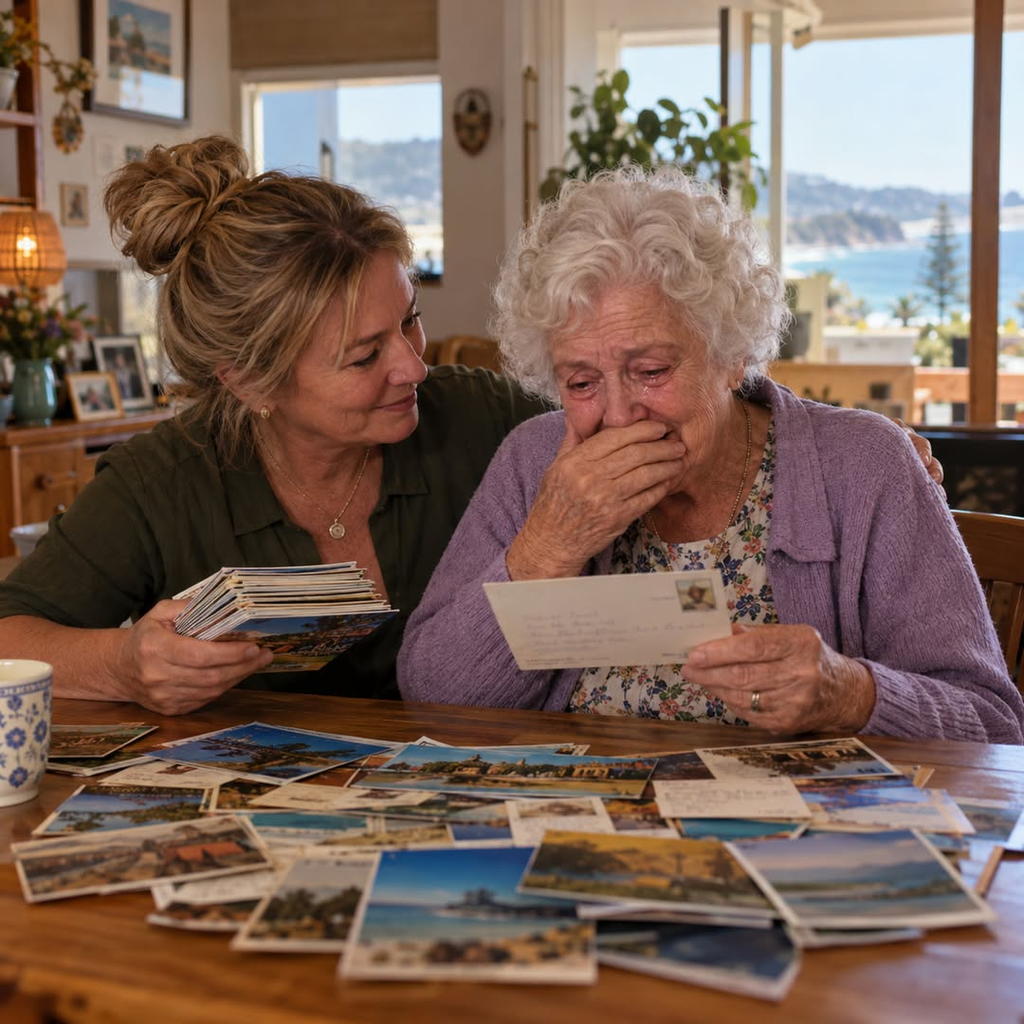
There were twenty-nine envelopes. Three were birthday cards from other relatives. The rest were mine, the stamps neatly cancelled, their edges unopened. Mum ran her fingers along the stack as though she could feel the missing Sundays. Ross said the cards were harmless and that he had only been trying to protect her. Mum looked at him and said, ‘Then why did you let me think she didn’t care?’
He had no answer. Neither did I. We sat around the little kitchen table with the cards between us, and I realised that the argument wasn’t really about mail. It was about who was allowed to decide what an old woman could bear to know.
PART 2
Mum didn’t want to read all twenty-nine envelopes at once. She chose the one with a kingfisher on the front because it reminded her of a bird she’d seen as a girl. I read it aloud slowly. It was about a woman at the library who’d returned a gardening book with a pressed leaf inside, and about my failed attempt to grow strawberries. Mum smiled. Then she asked me to read the next one. Ross sat at the far end of the table, staring at his hands.
After four cards she stopped. ‘I want to hear them when I have time to enjoy them,’ she said. ‘They were written for me, not for a competition.’ That sentence changed the afternoon. I had been thinking about proof: all the dates and stamps that would show I hadn’t forgotten her. Mum was thinking about getting her ordinary correspondence back, at her own pace. She didn’t need an investigation before she could decide whether she wanted to hear a joke about strawberries.
I asked Ross to explain what he had meant by protecting her. He said there had been several convincing scam letters after Mum’s wrist injury, including one that demanded a payment for a service she had never ordered. Mum had been frightened and had asked him to check official-looking mail with her. At the same time, she had been sleeping poorly and had said that too many people wanted answers from her. Ross had heard that as permission to filter everything.
Mum shook her head. ‘I asked you to help me check bills, not my daughter’s handwriting.’
Ross admitted he had begun putting cards aside without telling either of us. At first he planned to give them to her after a week or two. Then another arrived and another. When she asked whether I’d written, he panicked and said I was busy. The lie made the next card harder to deliver, because he would have had to explain all the ones before it. By the time the shoebox filled, he had persuaded himself that the whole subject would upset her too much.
I wanted to say he had done it because he liked being the indispensable child. There may have been some truth in that, but I didn’t have a way to know it, and saying it would not have helped Mum. Instead I asked what would happen now with her post. Mum answered before Ross could. She wanted her own letterbox key back. She wanted bills reviewed with her, not hidden from her. And she wanted both of us to ask before organising her life.
Ross argued that she might miss important correspondence. Mum replied that she could make a mistake and still have the right to read her own letters. That didn’t mean she wanted no help. She wanted help she could see. I offered to make a weekly list of appointments with her over the phone. Ross offered to keep driving her to the ones she couldn’t reach by bus. Mum accepted both offers and declined our suggestion of a shared folder on a phone app. She preferred a paper calendar with fat squares, and we finally listened.
There was still hurt between my brother and me. I asked why he had told me Mum didn’t want visitors. He admitted he had sometimes guessed she’d be tired without asking. He’d been trying to preserve the rhythm of his days because last-minute visits meant moving appointments and meals around. He was ashamed to say it. I was ashamed that I had left all the practical coordination to him and then treated my own good intentions as proof I’d done enough.
None of that excused withholding the cards. Mum made that clear. She told Ross she loved him and appreciated the shopping, but trust couldn’t mean he took possession of every message that arrived at her door. She asked for the cards back, for the letterbox key and for a week without either of us arguing over her head. We agreed.
I stayed for dinner. Mum made soup, and I chopped the carrots because her wrist still bothered her when she used a large knife. Ross washed up. We moved around each other awkwardly, like guests at a house where everyone should have felt at home. Before he left he apologised directly to Mum. He didn’t blame the scammers or say he’d only acted out of love. He said he’d made decisions she had not asked him to make and then lied about them. She thanked him for saying it plainly.
Afterward Mum chose another card. It showed a lighthouse. I’d written about a rainy Sunday and the smell of books drying near an open window. She listened and said, ‘I’d have liked to hear that on the day.’ I nodded. That was the part we couldn’t repair with a new arrangement. We could return the letters. We couldn’t return the Sundays.
PART 3
We started again with small things. Mum put her letterbox key on a bright yellow ribbon so she could find it easily. Ross still collected heavy parcels if she asked, but he didn’t open or sort her personal mail. She kept a tray for bills she wanted help understanding and another for letters she wanted to enjoy on her own. Sometimes she asked me to read a card over the phone. Sometimes she read one herself and rang to argue about my punctuation.
Ross and I made a visiting calendar, but Mum chose the dates. If she wanted a quiet week, she said so. If she wanted company, she called. I took on more appointment transport during the weeks I could arrange leave, and I stopped pretending that sending affectionate notes was the same as sharing the practical load. Ross stopped using his closeness to make every decision. We still irritated one another, because we are siblings, not saints. At least we began asking questions before making arrangements.
One afternoon Mum asked Ross to sit beside her while she opened the last card from the box. It was dated the week before I visited. I’d written that I was worried I hadn’t heard her usual laugh in a while and hoped we could sit together soon. Ross cried when he heard it. Mum put her hand on his shoulder. She didn’t say the problem had been harmless. She said she knew he’d been tired and scared of getting things wrong. He told her he should have asked for help instead of trying to control everything.
The following Sunday I sent a fresh postcard. It showed a kookaburra sitting on a fence, looking as though it had a very strong opinion about something. Mum rang two days later to tell me it was the ugliest card in my collection. I could hear her smile. It was the first card in months that felt like part of an ordinary week rather than evidence in a family quarrel.
At our next visit she made us sit down with tea and announced a rule of her own. No talking about her as if she were a parcel to be delivered from one child to another. If she needed more help later, we would work it out with her. If she changed her mind, we would ask again. She was not a problem to be passed between two busy adult children. She was our mother, a woman who had spent decades making decisions, some good and some terrible, just like the rest of us.
I don’t know how long she’ll be able to live independently. None of us does. But the uncertainty isn’t permission to erase her choices in advance. Helping her with a difficult letter and deciding she cannot receive a loving one are very different things. One can make a life easier. The other can make it smaller without anyone noticing.
The box of old postcards now sits in Mum’s bookcase. She keeps them because she likes the pictures, not because she needs reminding that I wrote. Sometimes she puts one on the fridge. Last week it was the kingfisher. I think about the months she looked into the empty letterbox and wondered whether I had forgotten her. I wish I could change that. What I can do is ring, visit, write and listen when she says what she actually wants.
If you discovered a relative had been hiding letters from an older parent ‘for their own good’, would you see it as a protective mistake or a breach of trust? I can understand how Ross became overwhelmed. I also know the only person who should have decided whether Mum read those cards was Mum herself.